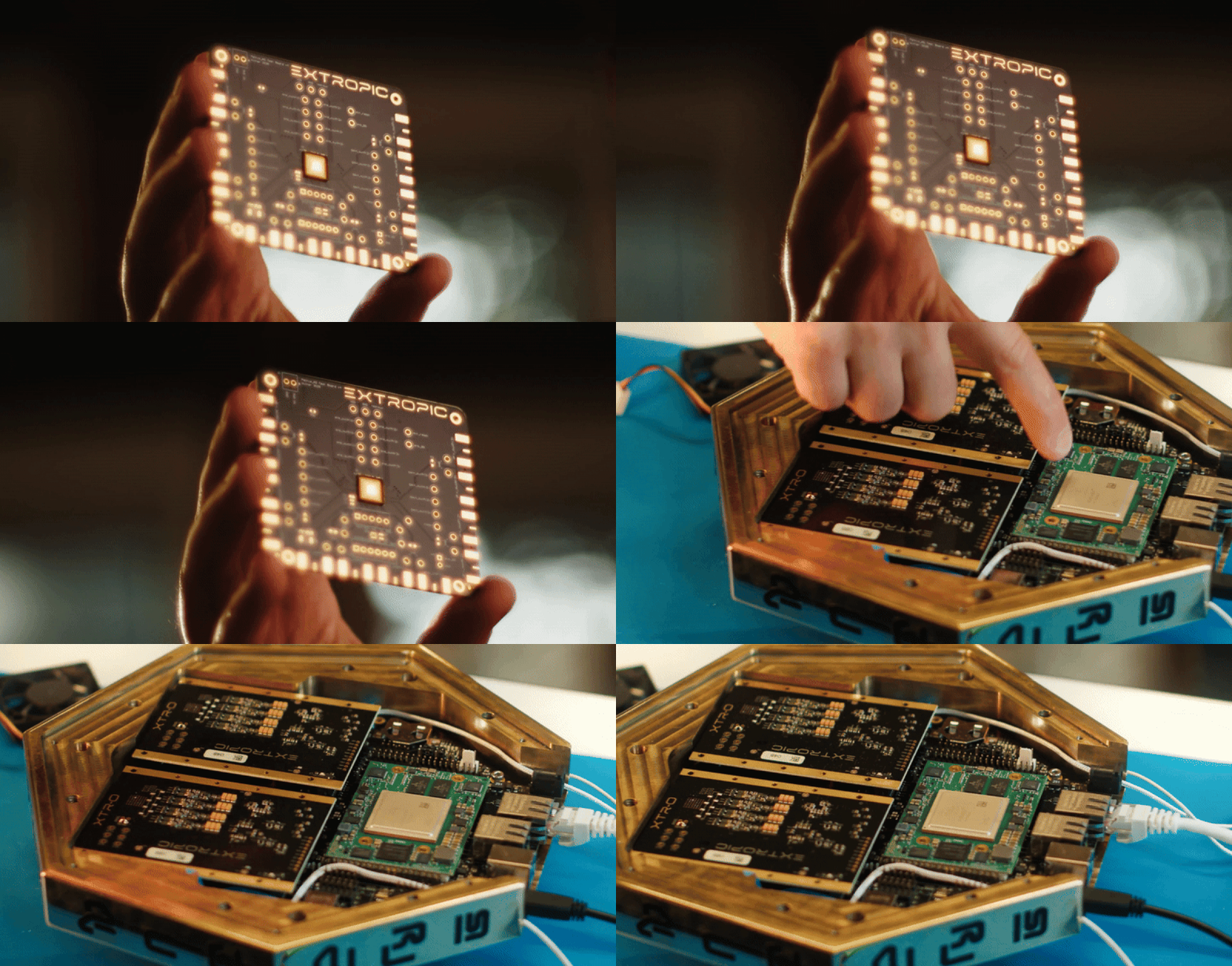
Category: News

  • Quantum Computing: Unlocking the Next Era of Computation

    Quantum Computing: Unlocking the Next Era of Computation

    Introduction

    Classical computing has driven humanity’s progress for decades—from the invention of the microprocessor to the modern era of cloud computing and AI. Yet, as Moore’s Law slows and computational problems become more complex, quantum computing has emerged as a revolutionary paradigm.

    Unlike classical computers, which process information using bits (0 or 1), quantum computers use qubits, capable of existing in multiple states at once due to the laws of quantum mechanics. This allows quantum computers to tackle problems that are practically impossible for even the world’s fastest supercomputers.

    In this blog, we’ll take a deep dive into the foundations, technologies, applications, challenges, and future of quantum computing.

    What Is Quantum Computing?

    Quantum computing is a field of computer science that leverages quantum mechanical phenomena—primarily superposition, entanglement, and quantum interference—to perform computations.

    • Classical bit → Either 0 or 1.
    • Quantum bit (qubit) → Can be 0, 1, or any quantum superposition of both.

    This means quantum computers can process an exponential number of states simultaneously, giving them enormous potential computational power.

    The Science Behind Quantum Computing

    1. Superposition

    A qubit can exist in multiple states at once. Imagine flipping a coin—classical computing sees heads or tails, but quantum computing allows heads + tails simultaneously.

    2. Entanglement

    Two qubits can become entangled, meaning their states are correlated regardless of distance. Measuring one immediately gives information about the other. This enables powerful quantum algorithms.

    3. Quantum Interference

    Quantum systems can interfere like waves—amplifying correct computational paths and canceling out incorrect ones.

    4. Quantum Measurement

    When measured, a qubit collapses to 0 or 1. The art of quantum algorithm design lies in ensuring measurement yields the correct answer with high probability.

    History and Evolution of Quantum Computing

    • 1980s → Richard Feynman and David Deutsch proposed the idea of quantum computers.
    • 1994 → Peter Shor developed Shor’s algorithm, showing quantum computers could break RSA encryption.
    • 1996 → Lov Grover introduced Grover’s algorithm for faster database search.
    • 2000s → Experimental prototypes built using superconducting circuits and trapped ions.
    • 2019 → Google claimed “quantum supremacy” with Sycamore processor solving a task beyond classical supercomputers.
    • 2020s → Quantum hardware advances (IBM, IonQ, Rigetti, Xanadu) + software frameworks (Qiskit, Cirq, PennyLane).

    Types of Quantum Computing Technologies

    There is no single way to build a quantum computer. Competing technologies include:

    1. Superconducting Qubits (Google, IBM, Rigetti)
      • Operate near absolute zero.
      • Scalable, but sensitive to noise.
    2. Trapped Ions (IonQ, Honeywell)
      • Qubits represented by ions held in electromagnetic traps.
      • High fidelity, but slower than superconductors.
    3. Photonic Quantum Computing (Xanadu, PsiQuantum)
      • Uses photons as qubits.
      • Room temperature operation and scalable.
    4. Topological Qubits (Microsoft’s approach)
      • More stable against noise, but still theoretical.
    5. Neutral Atoms & Cold Atoms
      • Use laser-controlled atoms in optical traps.
      • Promising scalability.

    Quantum Algorithms

    Quantum algorithms exploit superposition and entanglement to achieve exponential or polynomial speedups.

    • Shor’s Algorithm → Factorizes large numbers, breaking classical encryption.
    • Grover’s Algorithm → Speeds up unstructured search problems.
    • Quantum Simulation → Models molecules and materials at quantum level.
    • Quantum Machine Learning (QML) → Enhances optimization and pattern recognition.

    Applications of Quantum Computing

    1. Cryptography
      • Breaks classical encryption (RSA, ECC).
      • Enables Quantum Cryptography (quantum key distribution for secure communication).
    2. Drug Discovery & Chemistry
      • Simulates molecules for faster drug design.
      • Revolutionary for pharma, biotech, and material science.
    3. Optimization Problems
      • Logistics (airline scheduling, traffic flow).
      • Financial portfolio optimization.
    4. Artificial Intelligence & Machine Learning
      • Quantum-enhanced neural networks.
      • Faster training for large models.
    5. Climate Modeling & Energy
      • Simulating complex systems like weather patterns, battery materials, and nuclear fusion.

    Challenges in Quantum Computing

    1. Decoherence & Noise
      • Qubits are fragile and lose information quickly.
    2. Error Correction
      • Quantum error correction requires thousands of physical qubits for one logical qubit.
    3. Scalability
      • Building large-scale quantum computers (millions of qubits) remains unsolved.
    4. Cost & Infrastructure
      • Requires cryogenic cooling, advanced lasers, or photonics.
    5. Algorithm Development
      • Only a handful of useful quantum algorithms exist today.

    Quantum Computing vs Classical Computing

    AspectClassical ComputersQuantum Computers
    Unit of InfoBit (0 or 1)Qubit (superposition)
    ComputationSequential/parallelExponential states
    StrengthsReliable, scalableMassive parallelism
    WeaknessesSlow for complex problemsNoise, error-prone
    ApplicationsGeneral-purposeSpecialized (optimization, chemistry, cryptography)

    The Future of Quantum Computing

    • Short-term (2025–2030)
      • “NISQ era” (Noisy Intermediate-Scale Quantum).
      • Hybrid algorithms combining classical + quantum (e.g., variational quantum eigensolver).
    • Mid-term (2030–2040)
      • Breakthroughs in error correction and scaling.
      • Industry adoption in finance, logistics, healthcare.
    • Long-term (Beyond 2040)
      • Fault-tolerant, general-purpose quantum computers.
      • Quantum Internet enabling ultra-secure global communication.
      • Possible role in Artificial General Intelligence (AGI).

    Final Thoughts

    Quantum computing is not just a technological advancement—it’s a paradigm shift in computation. It challenges the very foundation of how we process information, promising breakthroughs in medicine, cryptography, climate science, and AI.

    But we are still in the early stages. Today’s devices are noisy, limited, and experimental. Yet, the pace of research suggests that quantum computing could reshape industries within the next few decades, much like classical computing transformed the world in the 20th century.

    The question is no longer “if” but “when”. And when it arrives, quantum computing will redefine what is computationally possible.

  • Boston Dynamics: Engineering the Future of Robotics

    Boston Dynamics: Engineering the Future of Robotics

    Introduction

    Robots have fascinated humanity for centuries—appearing in mythology, literature, and science fiction long before they became a technological reality. Today, one company sits at the forefront of turning those fantasies into real, walking, running, and thinking machines: Boston Dynamics.

    Founded in the early 1990s as an MIT spin-off, Boston Dynamics has transformed from a niche research lab into a global symbol of next-generation robotics. Its robots—whether the dog-like Spot, the acrobatic Atlas, or the warehouse-focused Stretch—have captivated millions with their lifelike movements. Yet behind the viral YouTube clips lies decades of scientific breakthroughs, engineering challenges, and ethical debates about the role of robots in society.

    This blog takes a deep dive into Boston Dynamics, exploring not only its famous machines but also the technology, impact, controversies, and future of robotics.

    Historical Journey of Boston Dynamics

    Early Foundations (1992–2005)

    • Founded in 1992 by Marc Raibert, a former MIT professor specializing in legged locomotion and balance.
    • Originally focused on simulation software (e.g., DI-Guy) for training and virtual environments.
    • Pivoted toward legged robots through DARPA (Defense Advanced Research Projects Agency) contracts.

    DARPA Era & Military Robotics (2005–2013)

    • BigDog (2005): Four-legged robot developed with DARPA and the U.S. military for carrying equipment over rough terrain.
    • Cheetah (2011): Set a land-speed record for running robots.
    • LS3 (Legged Squad Support System): Intended as a robotic mule for soldiers.
    • These projects cemented Boston Dynamics’ reputation for creating robots with unprecedented mobility.

    Silicon Valley Years (2013–2017)

    • Acquired by Google X (Alphabet) in 2013, aiming to commercialize robots.
    • Focus shifted toward creating robots for industrial and civilian use, not just military contracts.

    SoftBank Ownership (2017–2020)

    • SoftBank invested heavily in robotics, seeing robots as companions and workforce supplements.
    • Spot became the first commercially available Boston Dynamics robot during this era.

    Hyundai Era (2020–Present)

    • Hyundai Motor Group acquired 80% of Boston Dynamics for ~$1.1 billion.
    • Focus on integrating robotics into smart factories, mobility, and AI-driven industries.

    Robots That Changed Robotics Forever

    Spot: The Robotic Dog

    • Specs: 25 kg, 90-minute battery life, multiple payload options.
    • Capabilities: Climbs stairs, navigates uneven terrain, carries 14 kg payload.
    • Applications:
      • Industrial inspection (oil rigs, construction sites).
      • Security patrols.
      • Search-and-rescue missions.
      • Mapping hazardous zones.

    Atlas: The Humanoid Athlete

    • Specs: 1.5 meters tall, ~89 kg, hydraulic actuation.
    • Capabilities:
      • Parkour, gymnastics, flips.
      • Object manipulation and lifting.
      • Advanced balance in dynamic environments.
    • Significance: Demonstrates human-like locomotion and agility, serving as a testbed for future humanoid workers.

    BigDog & LS3: Military Pack Mules

    • Funded by DARPA to support soldiers in terrain where vehicles couldn’t go.
    • Carried 150 kg payloads over ice, mud, and steep slopes.
    • Retired due to noise (too loud for combat use).

    Stretch: The Warehouse Specialist

    • Designed specifically for logistics and supply chain automation.
    • Equipped with:
      • Robotic arm with suction-based gripper.
      • Vision system for recognizing boxes.
      • Battery for full-shift operation.
    • Boston Dynamics’ first mass-market industrial robot aimed at solving global e-commerce challenges.

    The Science & Technology

    Boston Dynamics’ robots are not just machines—they are embodiments of cutting-edge science:

    1. Biomechanics & Dynamics
      • Inspired by animals and humans, robots are built to balance dynamically rather than rigidly.
      • Real-time algorithms calculate adjustments at millisecond scales.
    2. AI & Machine Learning
      • Robots use reinforcement learning and neural networks for navigation, obstacle avoidance, and decision-making.
    3. Perception Systems
      • Combination of LiDAR, depth cameras, stereo vision, and IMUs (inertial measurement units).
      • Enables environmental awareness for autonomous navigation.
    4. Actuation & Materials
      • Hydraulic systems (Atlas) allow explosive strength.
      • Electric motors (Spot) improve efficiency.
      • Lightweight composites reduce energy consumption.
    5. Human-Robot Interface
      • Controlled via tablets, joystick, or fully autonomous mode.
      • API support enables integration into custom workflows.

    Real-World Applications

    Boston Dynamics robots are moving from labs into real-world industries:

    • Energy & Utilities: Spot inspects oil rigs, nuclear plants, wind turbines.
    • Warehousing & Logistics: Stretch unloads trucks and reduces manual labor.
    • Public Safety: Used in disaster zones (COVID hospital delivery, earthquake response).
    • Construction: 3D mapping of construction sites, progress monitoring.
    • Agriculture: Early experiments with Spot monitoring crops and livestock.

    Ethical, Social & Economic Implications

    1. Job Displacement vs. Augmentation
      • Stretch could replace warehouse workers, sparking debates about automation’s impact.
      • Advocates argue robots handle dangerous and repetitive tasks, freeing humans for higher-level work.
    2. Militarization Concerns
      • Early DARPA links raised fears of weaponized robots.
      • In 2021, Boston Dynamics signed a pledge against weaponization.
    3. Surveillance & Privacy
      • Spot used by police sparked criticism, with concerns about robot policing and surveillance.
    4. Human Perception & Trust
      • People often anthropomorphize robots, creating emotional connections.
      • Raises philosophical questions: Should robots have “rights”? Should they replace human interaction in some contexts?

    Boston Dynamics in the Global Robotics Race

    Boston Dynamics is not alone. Other companies are racing toward the robotics revolution:

    • Tesla Optimus – General-purpose humanoid robot for factories.
    • Agility Robotics (Digit) – Humanoid for logistics and retail.
    • ANYbotics – Quadrupeds for inspection.
    • Unitree Robotics – Affordable robot dogs (China).

    Boston Dynamics is unique for combining engineering precision with viral demonstrations, making robotics both practical and culturally iconic.

    The Future of Boston Dynamics

    1. Commercial Expansion
      • Spot and Stretch becoming industry standards.
      • Subscription-based “Robotics-as-a-Service” (RaaS) models.
    2. Humanoids for Everyday Use
      • Atlas’ technologies may one day scale into humanoid workers for factories, hospitals, and homes.
    3. Robotics + AI Integration
      • With generative AI and improved autonomy, robots may learn tasks on-the-fly instead of being programmed.
    4. Hyundai Vision
      • Merging mobility (cars, drones, robots) into smart cities and connected living ecosystems.

    Extended Comparison Table

    RobotYearTypeKey FeaturesApplicationsStatus
    BigDog2005QuadrupedHeavy load, rough terrainMilitary logisticsRetired
    Cheetah2011QuadrupedFastest running robot (28 mph)Military researchRetired
    LS32012QuadrupedMule for soldiers, 180 kg loadDefenseRetired
    Atlas2013+HumanoidParkour, manipulation, agilityResearch, humanoid testingActive (R&D)
    Spot2015+QuadrupedAgile, sensors, modular payloadsIndustry, inspection, SARCommercial
    Stretch2021IndustrialRobotic arm + vision systemLogistics, warehousingCommercial

    Final Thoughts

    Boston Dynamics is not just building robots—it is building the future of human-machine interaction.

    • It represents engineering artistry, blending biomechanics, AI, and machine control into lifelike motion.
    • It sparks both awe and fear, as people wonder: Will robots liberate us from drudgery, or compete with us in the workforce?
    • It is shaping the next era of automation, mobility, and humanoid robotics, where machines could become coworkers, assistants, and perhaps even companions.

    Boston Dynamics’ journey is far from over. As robotics moves from viral videos to industrial ubiquity, the company stands as both a pioneer and a symbol of humanity’s endless pursuit to bring machines to life.

  • Sci-Hub: The Pirate Bay of Science or the Liberator of Knowledge?

    Sci-Hub: The Pirate Bay of Science or the Liberator of Knowledge?

    Introduction: The Knowledge Divide

    Human civilization has always advanced through knowledge-sharing. From papyrus scrolls to printing presses to the internet, the faster we distribute information, the quicker we progress. Yet, in the 21st century, when information flows instantly, most of the world’s scientific knowledge remains locked behind paywalls.

    Enter Sci-Hub, the platform that dared to challenge the status quo. Since 2011, it has made millions of research papers freely available to students, researchers, and curious minds. For some, it is an act of intellectual Robin Hood; for others, it is digital piracy on a massive scale.

    Origins: Alexandra Elbakyan’s Vision

    • Founder: Alexandra Elbakyan, born in Kazakhstan (1988).
    • Background: Computer scientist & neuroscientist, frustrated with paywalls.
    • Inspiration: While working on her research, she was blocked by paywalls that demanded $30–$50 per paper. For a student from a developing country, this was impossible to afford.
    • Creation: In 2011, she launched Sci-Hub, using automated scripts and university proxies to bypass paywalls and fetch academic papers.

    Within months, Sci-Hub gained popularity among researchers worldwide.

    How Sci-Hub Works (Behind the Scenes)

    1. Request Handling: A user enters the DOI (Digital Object Identifier) of a paper.
    2. Bypassing Paywalls: Sci-Hub uses institutional credentials (often donated anonymously by academics) to fetch the paper.
    3. Storage: The paper is stored in Sci-Hub’s database (called Library Genesis, or LibGen).
    4. Instant Access: The next time someone requests the same paper, Sci-Hub serves it instantly.

    Result: A snowball effect, where more downloads continuously expand its library, creating the world’s largest open scientific archive.

    Scale of Sci-Hub

    • Papers hosted: ~88 million (as of 2025).
    • Daily requests: Over 500,000 downloads.
    • Languages: Covers research in English, Chinese, Russian, Spanish, and more.
    • Domains: Has shifted across dozens of domains (.org, .io, .se, .st) to survive shutdowns.

    The Legal Battlefront

    1. Elsevier vs. Sci-Hub (2015)

    • Elsevier won a U.S. lawsuit; domains were seized.
    • Elbakyan faced an injunction and $15M damages.

    2. India’s Landmark Case (2020–Present)

    • Elsevier, Wiley, and ACS sued Sci-Hub & LibGen in the Delhi High Court.
    • Indian researchers protested, arguing paywalls harmed innovation.
    • Case ongoing, with court reluctant to block due to public interest.

    3. Russia and Global Support

    • Russia openly defended Sci-Hub, citing public access to knowledge as essential.
    • China has unofficially tolerated Sci-Hub, leading to massive usage.

    Sci-Hub operates in a gray zone: illegal under copyright law, but morally justified for many academics.

    The Economics of Academic Publishing

    The Sci-Hub debate highlights the broken economics of publishing:

    • Profit Margins: Elsevier’s profit margin (37%) is higher than Apple, Google, or Amazon.
    • Pay-to-Play Model: Universities pay millions for journal subscriptions.
    • Double Burden: Researchers write papers & review them for free, yet publishers charge others to read them.
    • Article Processing Charges (APCs): Open-access journals often charge $1,500–$5,000 per article, shifting the burden to authors.

    This system creates knowledge inequality, locking out poorer nations.

    The Global Impact of Sci-Hub

    1. Developing Countries: In Africa, South Asia, and Latin America, Sci-Hub is often the only way to access research.
    2. COVID-19 Pandemic: During 2020–21, researchers heavily used Sci-Hub to study virology & vaccines when publishers lagged in making research free.
    3. Academic Productivity: A 2018 study found countries with higher Sci-Hub usage saw faster growth in publication output.

    Criticism and Ethical Concerns

    • Copyright Violation: Clear breach of intellectual property law.
    • Security Risks: Fake Sci-Hub mirrors sometimes host malware.
    • Dependence: Over-reliance on Sci-Hub may discourage systemic reforms.
    • Ethics: Does “the end (knowledge for all) justify the means (piracy)?”

    Alternatives to Sci-Hub (Legal)

    PlatformFocus AreaAccessibilityLimitation
    arXivPhysics, Math, CSFree preprintsNot peer-reviewed
    PubMed CentralLife SciencesFreeLimited to biomedical
    DOAJMultidisciplinary18,000+ journalsQuality varies
    UnpaywallBrowser add-onFinds legal free PDFsNot always available
    ResearchGateAuthor uploadsFreeCopyright issues

    Future of Sci-Hub and Open Access

    1. Rise of AI-Driven Knowledge Platforms
      • AI summarizers (like Elicit, Perplexity) could repackage open papers.
      • AI models may train on Sci-Hub’s library, creating unofficial AI scholars.
    2. Policy Shifts
      • Plan S (Europe): Mandates open access for publicly funded research.
      • India’s One Nation, One Subscription: Aims to provide nationwide access to journals.
    3. Ethical Evolution
      • The fight is moving from piracy debates to equity in science.
      • Sci-Hub may fade if global open-access adoption accelerates.

    Final Thoughts

    Sci-Hub is more than a website—it’s a symbol of resistance against knowledge inequality.

    • To publishers, it’s theft.
    • To researchers in developing nations, it’s hope.
    • To history, it may be remembered as the catalyst for Open Science.

    The central question remains: Should knowledge created by humanity be owned, or shared freely as a collective resource?

    If the future belongs to open access, then Sci-Hub will have played a historic role in dismantling the paywalls that once slowed human progress.

  • Goa Shipyard Limited (GSL) Management Trainee Recruitment 2025: A Complete Guide

    Goa Shipyard Limited (GSL) Management Trainee Recruitment 2025: A Complete Guide

    Goa Shipyard Limited (GSL), a prestigious Public Sector Undertaking under India’s Ministry of Defence, is inviting applications for Management Trainee posts in 2025. Based in Vasco da Gama, Goa, GSL specializes in shipbuilding for the Indian Navy, Coast Guard, and exports. Here’s everything you need to know about this exciting opportunity.

    Company Overview

    Established in 1957, GSL has evolved into one of India’s premier shipbuilding yards, certified under ISO 9001 (Quality), ISO 14001 (Environmental), and ISO 45001 (Health & Safety) standards. With over 1600 skilled staff and 200+ engineers, GSL excels in building and repairing defense.

    Recruitment Details — What’s New in 2025?

    Positions & Vacancies

    • Management Trainee (various disciplines)
    • Junior Project Executive (engineering roles)
    • Total vacancies: 62 posts.

    Key Dates

    • Application Opens: 25 August 2025
    • Last Date: 24 September 2025.

    Eligibility Criteria

    FactorDetails
    Age LimitUR: ≤28 years; OBC: ≤31 years; SC/ST: ≤33 years (as of application date).
    EducationB.E./B.Tech (Engineering roles); CA/ICMA for Finance; Robotics degree for that specific slot.
    MarksMinimum First Class (≥60% marks or equivalent CGPA).
    NationalityIndian only

    Pay Scale & Benefits

    • IDA Pay Scale: ₹40,000–₹1,40,000 (Grade E-1).
    • Additional perks: DA (~40%), HRA (Goa ~18%), and various allowances (up to 35%).

    Selection Process

    1. Written Test (online or offline)
    2. Interview / GD
    3. Document Verification

    Candidates are shortlisted based on combined performance in written test and interview/document verification.

    Application Process

    1. Visit GSL’s official Careers page under “Notice Board”.
    2. Click Apply Now, review eligibility, and register.
    3. Fill out the application form and upload scanned documents.
    4. Pay the ₹500 application fee (WAIVED for SC/ST/PwBD/Ex-servicemen).
    5. Submit before 24 September 2025.

    📥 Click Here to Apply Online

    📄 Download Official Notification PDF

    Organizational Advantage

    • GSL maintains state-of-the-art facilities, including CAD/CAM design, ERP systems, and modern manufacturing shops.
    • Induction and training programs are robust, enabling new recruits to quickly integrate and excel.

    Why Join as a Management Trainee?

    • Contribute to building cutting-edge defense vessels like FPVs (Adamya-class) commissioned in 2025.
    • Be part of a fast-growing PSU—FY24 saw 100% revenue growth and 76% jump in profits.
    • Work at the forefront of shipbuilding innovation, helping safeguard India’s maritime security.

    Preparation Tips

    • Understand GSL operations – know the ship types, technologies, and recent achievements.
    • Solidify technical fundamentals in your domain (e.g., mechanical, naval, electronics).
    • Practice written exam formats—look for past GSL MT questions, mock tests.
    • Prepare for the interview — emphasize leadership potential, problem-solving, and alignment with GSL’s mission.
    • Stay updated—check GSL’s website frequently for notification updates, admit card info, and changes.

    Final Thoughts

    The GSL Management Trainee recruitment in 2025 is a rare chance to join a prestigious defense-focused PSU at an early, influential stage of your career. With strong growth, advanced facilities, and national impact, GSL offers a promising trajectory for young engineers.

    Just make sure to carefully check eligibility and apply before 24 September 2025—then prepare smartly to convert this opportunity into your future.

  • BitChat: The Future of Secure, Decentralized Messaging

    BitChat: The Future of Secure, Decentralized Messaging

    In an era where digital privacy is under constant threat, centralized messaging apps have become both essential and risky. Despite end-to-end encryption, the centralization of data still makes platforms like WhatsApp, Telegram, and Signal vulnerable to outages, censorship, or abuse by platform owners.

    Enter BitChat — a decentralized, peer-to-peer messaging system that leverages blockchain, distributed networks, and cryptographic protocols to create a truly private, censorship-resistant communication tool.

    What is BitChat?

    BitChat is a peer-to-peer, decentralized chat application that uses cryptographic principles — often backed by blockchain or distributed ledger technologies — to enable secure, private, and censorship-resistant communication.

    Unlike centralized messaging apps that route your data through servers, BitChat allows you to chat directly with others over a secure, distributed network — with no single point of failure or control.

    Depending on the implementation, BitChat can be:

    • A blockchain-based messaging platform
    • A DHT-based (Distributed Hash Table) P2P chat protocol
    • A layer on top of IPFS, Tor, or libp2p
    • An open-source encrypted communication client

    Key Features of BitChat

    1. End-to-End Encryption (E2EE)

    Messages are encrypted before leaving your device and decrypted only by the recipient. Not even network relays or intermediaries can read the content.

    2. Decentralization

    No central servers. Communication happens peer-to-peer or through a distributed network like Tor, IPFS, or a blockchain-based protocol (e.g., Ethereum, NKN, or Hypercore).

    3. Censorship Resistance

    No single entity can block, throttle, or moderate your communication. Ideal for journalists, activists, or users in restricted regions.

    4. Anonymity & Metadata Protection

    Unlike most chat apps that log IPs, timestamps, and metadata, BitChat can obfuscate or hide this information — especially if used over Tor or I2P.

    5. Blockchain Integration (Optional)

    Some BitChat variants use blockchain to:

    • Register user identities
    • Verify keys
    • Timestamp messages (immutable audit trails)
    • Enable smart contract-based interactions

    How BitChat Works (Architecture Overview)

    Here’s a simplified version of how a BitChat system might operate:

    [User A] ↔ [DHT / Blockchain / P2P Node] ↔ [User B]
    

    Components

    • Identity Layer: Public-private key pair (often linked to a blockchain address or DID)
    • Transport Layer: Libp2p, NKN, IPFS, Tor hidden services, or WebRTC
    • Encryption Layer: AES, RSA, Curve25519, or post-quantum cryptography
    • Interface Layer: Chat UI built with frameworks like Electron, Flutter, or React Native

    Why BitChat Matters

    Problem with Traditional MessagingBitChat’s Solution
    Centralized servers = attack vectorDecentralized P2P network
    Governments can block appsBitChat runs over censorship-resistant networks
    Metadata leaksBitChat obfuscates or avoids metadata logging
    Requires phone number/emailBitChat uses public keys or anonymous IDs
    Prone to surveillanceMessages are E2E encrypted, often anonymously routed

    Use Cases

    1. Journalism & Activism

    Secure communication between journalists and sources in oppressive regimes.

    2. Developer-to-Developer Chat

    No third-party involvement — useful for secure remote engineering teams.

    3. Web3 Ecosystem

    Integrates with dApps or blockchain wallets to support token-gated communication, NFT-based identities, or DAO-based chat rooms.

    4. Anonymous Communication

    Enables communication between parties without requiring names, phone numbers, or emails.

    Popular BitChat Implementations (or Similar Projects)

    ProjectDescription
    BitmessageDecentralized messaging protocol using proof-of-work
    SessionAnonymous chat over the Loki blockchain, no phone numbers
    NKN + nMobileChat and data relay over decentralized NKN network
    Status.imEthereum-based private messenger and crypto wallet
    Matrix + ElementFederated secure chat, often used in open-source communities

    If you’re referring to a specific BitChat GitHub project or protocol, I can do a deep dive into that version too.

    Sample Architecture (Developer Perspective)

    Here’s how a developer might build or interact with BitChat:

    1. Identity:
      • Generate wallet or keypair (e.g., using Ethereum, Ed25519, or DID)
      • Derive a unique chat address
    2. Transport Layer:
      • Use libp2p for direct peer connections
      • Fallback to relay nodes if NAT traversal fails
    3. Encryption:
      • Use E2EE with ephemeral keys for forward secrecy
      • Encrypt file transfers with symmetric keys, shared securely
    4. Storage (Optional):
      • Use IPFS or OrbitDB for distributed message history
      • Or keep everything ephemeral (no storage = more privacy)
    5. Frontend/UI:
      • Cross-platform client using Electron + WebRTC or Flutter + libp2p

    Challenges & Limitations

    ChallengeImpact
    Network latencyP2P messaging may be slower than centralized services
    User onboardingWithout phone/email, key management can be confusing
    No account recoveryLose your private key? You lose your identity
    ScalabilityBlockchain-backed messaging can be expensive and slow
    Spam/DOS protectionNeed Proof-of-Work, token gating, or rate limits

    The Future of Decentralized Messaging

    With growing concerns about privacy, censorship, and digital sovereignty, BitChat-like platforms could soon become mainstream tools. Web3, zero-knowledge cryptography, and AI-powered agents may further extend their capabilities.

    Emerging Trends:

    • Wallet-based login for chat (e.g., Sign-in with Ethereum)
    • Token-gated communities (e.g., DAO chats)
    • AI chat agents on decentralized protocols
    • End-to-end encrypted group video calls without centralized servers

    Final Thoughts

    BitChat represents a bold step forward in reclaiming privacy and ownership in digital communication. By embracing decentralization, encryption, and user sovereignty, it offers a secure alternative to traditional messaging platforms — one where you own your data, identity, and freedom.

    Whether you’re a developer, privacy advocate, or simply someone who values autonomy, BitChat is worth exploring — and possibly building on.

    “Privacy is not a feature. It’s a fundamental right. And BitChat helps make that right real.”

    Resources

  • Escaping the Scroll: Reclaiming Your Brain from Digital Overload

    Escaping the Scroll: Reclaiming Your Brain from Digital Overload

    What Is Brain Rot?

    “Brain rot” (or brainrot) became Oxford’s 2024 Word of the Year, capturing the collective anxiety around how endless, low-quality digital content might dull our minds Imagine doom-scrolling TikTok shorts or memes until your brain feels foggy, forgettable, and emotionally numb — that’s the essence of brain rot.

    How It Develops

    • Fast, shallow content: Quick hits trigger dopamine, but don’t sustain learning or focus.
    • Infinite scroll: Social feeds exploit bottomless navigation to hook your brain’s reward loop, tapping into the habenula — which shuts motivation off at will .
    • Media multitasking: Constant switching between apps and tabs fragments attention and reduces memory efficiency.
    • Passive consumption: Doom-scrolling or binge-watching numbs your mental energy, harming concentration and memory.

    The Mental Impacts

    1. Shorter attention spans & mental fog — struggling to read or think deeply .
    2. Memory struggles — forgetting things moments after seeing them.
    3. Motivation drop & decision fatigue — the brain’s reward response begins to blunt.
    4. Rising anxiety & apathy — from doom-scrolling negative news to emotional desensitization .
    5. Actual brain changes — studies note altered brain activity in reward/emotion areas (orbitofrontal cortex, cerebellum) for heavy short-video users.

    How to Overcome Brain Rot

    1. Set Digital Boundaries

    • Use screen timers or app limits to curb passive screen time.
    • Move addictive apps out of sight to introduce friction before opening them.
    • Establish tech-free zones (e.g., at mealtimes, 1–2 hours before bed).

    2. Curate Your Content

    • Follow accounts with meaningful, educational, or creative value.
    • Adopt an 80/20 rule: 80% deep, useful content; 20% light, entertaining stuff .

    3. Practice Mindful Consumption

    • Use the 20–20–20 rule: every 20 min look 20 sec at something 20 ft away.
    • Schedule focused sessions (e.g., Pomodoro) to build deep attention .

    4. Rebuild Focus and Well‑Being

    • Read, play puzzles, learn skills — these reinforce brain resilience.
    • Move, sleep well, eat brain-nourishing foods — basics for cognitive recovery .
    • Get outside regularly — even brief time in nature refreshes attention .

    5. Perform Digital Detoxes

    • Try tech-free time blocks, even half-days or full weekends, to reset habit loops .

    6. Seek Support if Needed

    • Talk to peers, use group accountability, or consult a mental-health professional for deeper struggles .

    Sample Weekly Reset Plan

    DayFocus
    Mon–Fri30 min limit on social apps
    EveningsNo screens after 9 pm
    Sat1 hr nature walk + reading
    SunHalf-day digital detox; puzzle or hobby time

    Final Thoughts

    Brain rot isn’t an official diagnosis—but it’s a real signal that our digital habits are stressing our minds. By reclaiming focus, moderating tech use, and cultivating enriching offline routines, you can restore mental clarity, attention, creativity, and balance.

  • HPCL Recruitment 2025-26 Notification Out – 247 Officer & Junior Executive Posts | Apply Online

    HPCL Recruitment 2025-26 Notification Out – 247 Officer & Junior Executive Posts | Apply Online

    Hindustan Petroleum Corporation Limited (HPCL) has officially released the Recruitment Notification for Officers and Junior Executive Officers under Advertisement No. HPCL/OPEN/HR/1/2025-26. A total of 247 vacancies have been announced across various disciplines including engineering, law, HR, chartered accountancy, and safety.

    This recruitment drive is a golden opportunity for qualified professionals to join HPCL, one of India’s premier public sector energy companies.

    Important Dates

    EventDate
    Application Start Date5 June 2025
    Last Date to Apply Online30 June 2025
    Mode of ApplicationOnline
    Official Websitehindustanpetroleum.com

    HPCL Recruitment 2025 Overview

    DetailsInformation
    OrganizationHindustan Petroleum Corporation Limited (HPCL)
    Post NameOfficers & Junior Executive Officers
    Advertisement No.HPCL/OPEN/HR/1/2025-26
    Total Vacancies247
    Application ModeOnline
    Selection ProcessCBT + Group Task/Interview/Skill Test (as per post)

    Post-Wise Vacancy

    Post NameVacancies
    Junior Executive (Engineering)160
    Officer – Legal17
    Officer – HR20
    Chartered Accountant10
    Safety Officer30
    Welfare Officer10
    OthersAs per notification

    For detailed post-wise qualifications and criteria, refer to the official notification PDF.

    Eligibility Criteria

    • Educational Qualification:
      Varies by post. Includes Diploma, B.Tech, LL.B, CA, MBA, etc., from recognized institutions.
    • Experience:
      Some posts require 0–5 years of relevant experience. Freshers may be eligible for specific roles.
    • Age Limit:
      Usually between 25–30 years depending on the post. Age relaxation applies per government rules.

    Application Fee

    CategoryFee
    General/OBC/EWS₹1180 (₹1000 + 18% GST)
    SC/ST/PwBDNIL

    Selection Process

    • Computer-Based Test (CBT) – for applicable posts
    • Skill Test / Group Task / Interview – post shortlisting
    • Final selection will depend on performance and document verification.

    How to Apply

    1. Visit the official HPCL Careers portal:
      https://www.hindustanpetroleum.com
    2. Go to Careers > Job Openings
    3. Find the post titled:
      “Recruitment of Officers and Junior Executive Officers – Advt. No. HPCL/OPEN/HR/1/2025-26”
    4. Register and fill out the online application form.
    5. Upload scanned documents (photo, signature, certificates, etc.)
    6. Pay the application fee (if applicable)
    7. Submit the form and save the confirmation page.

    📥 Click Here to Apply Online – HPCL Careers


    📄 Download Official Notification PDF – Advt. No. HPCL/OPEN/HR/1/2025-26

    Final Thoughts

    This HPCL 2025-26 recruitment drive offers a rare opportunity for young professionals and experienced candidates to enter a dynamic and growth-oriented PSU career. With a wide range of posts and disciplines, this is your chance to join a Fortune 500 company and play a role in India’s energy sector.

    Ensure to apply before the deadline and take the first step towards a rewarding career with HPCL!

  • ISRO Scientist/Engineer Recruitment 2025 Notification Out – Apply for 320 Vacancies

    ISRO Scientist/Engineer Recruitment 2025 Notification Out – Apply for 320 Vacancies

    The Indian Space Research Organisation (ISRO) has officially released the ISRO Scientist/Engineer ‘SC’ Recruitment 2025 notification. This is a golden opportunity for engineering graduates in Electronics, Mechanical, and Computer Science disciplines to join one of India’s premier research organizations. A total of 320 vacancies have been announced.

    • Online Application Dates: 27 May to 16 June 2025
    • Selection Process: Written Test & Interview
    • Application Fee: ₹750 (Refundable as per rules)

    ISRO Recruitment 2025 Overview

    DetailsInformation
    OrganizationIndian Space Research Organisation (ISRO)
    Post NameScientist/Engineer ‘SC’
    Advertisement No.ISRO:ICRB:02(EMC):2025
    Total Vacancies320
    DisciplinesElectronics, Mechanical, Computer Science
    Selection ProcessWritten Test + Interview (50% weightage each)
    Mode of ApplicationOnline
    Official Websitewww.isro.gov.in

    Important Dates

    EventDate
    Application Start Date27 May 2025
    Last Date to Apply16 June 2025
    Last Date for Fee Payment18 June 2025

    ISRO Scientist/Engineer Vacancy 2025

    Post CodeDisciplineVacancies
    BE001Electronics113
    BE002Mechanical160
    BE003Computer Science44
    BE001 (PRL)Electronics – PRL2
    BE003 (PRL)Computer Science – PRL1
    Total320

    Eligibility Criteria

    • Educational Qualification: BE/BTech or equivalent in Electronics, Mechanical, or Computer Science with minimum 65% marks or CGPA of 6.84/10.
    • GATE Score: Valid GATE 2021 or later score required.
    • Final Year Students: Eligible if completing degree by 31 August 2025.
    • Age Limit: Maximum 28 years as on 16 June 2025. Age relaxation applicable as per Government norms.

    Application Fee (Refundable)

    CategoryFee Details
    All Candidates₹750 initially
    Women/SC/ST/PwBD/Ex-ServicemenFull refund on appearing in written test
    Others₹500 refund on appearing (₹250 processing fee non-refundable)

    ISRO Scientist/Engineer Exam Pattern 2025

    • Part A: 80 MCQs (Engineering stream) – 1 mark each, 1/3 negative marking, 2 hours
    • Part B: 15 Aptitude & Reasoning questions – 20 marks, no negative marking
    • Total: 95 questions, 100 marks

    Selection Process

    1. Written Exam – Shortlist in 1:5 ratio per post
    2. Interview – Final merit based on 50% written test + 50% interview

    Candidates must perform well in both stages to secure selection.

    How to Apply for ISRO Recruitment 2025

    1. Visit the official ISRO website: www.isro.gov.in
    2. Navigate to the recruitment section.
    3. Click on “Apply Online” for Scientist/Engineer ‘SC’.
    4. Fill in the application form carefully and upload required documents.
    5. Pay the application fee online before 18 June 2025.
    6. Save the registration number and confirmation page.

    📥 Click Here to Apply Online

    📄 Download Official Notification PDF

    Final Thoughts

    ISRO’s Scientist/Engineer ‘SC’ recruitment is a prestigious opportunity for aspiring engineers to contribute to India’s space missions and research. With attractive career growth, a challenging work environment, and a chance to work on cutting-edge technology, this recruitment drive is not to be missed!

    Apply before the deadline and begin your journey with ISRO!